
You just bought a shiny set of juggling bean bags. You feel the excitement of a new hobby. You toss the first one and it bounces right out of your hand. Most new bean bags arrive stiff and overfilled. Manufacturers often pack them tight to ensure they survive shipping and look great on shelves. This rigidity makes them hard to catch. You need a “dead” drop where the bag hits your palm and stays there.
Why You Need to Break In New Juggling Bean Bags
Stiff bags create a frustrating experience for beginners. A hard bean bag acts more like a ball. It bounces when it hits your hand or the floor. You want the filling to shift easily within the fabric shell. Soft bags conform to your grip and absorb the energy of the catch. The internal pellets need room to move.
Juggling involves a “catch and release” rhythm. Rigid seams disrupt this flow. You will find that broken-in bags improve your accuracy. They stop rolling away every time you drop them.
4 Fast Methods to Soften Your Bean Bags
Choose one of these proven techniques to get your bean bags ready for high-performance practice sessions in minutes.
1. The Kneading (Pizza Dough) Method
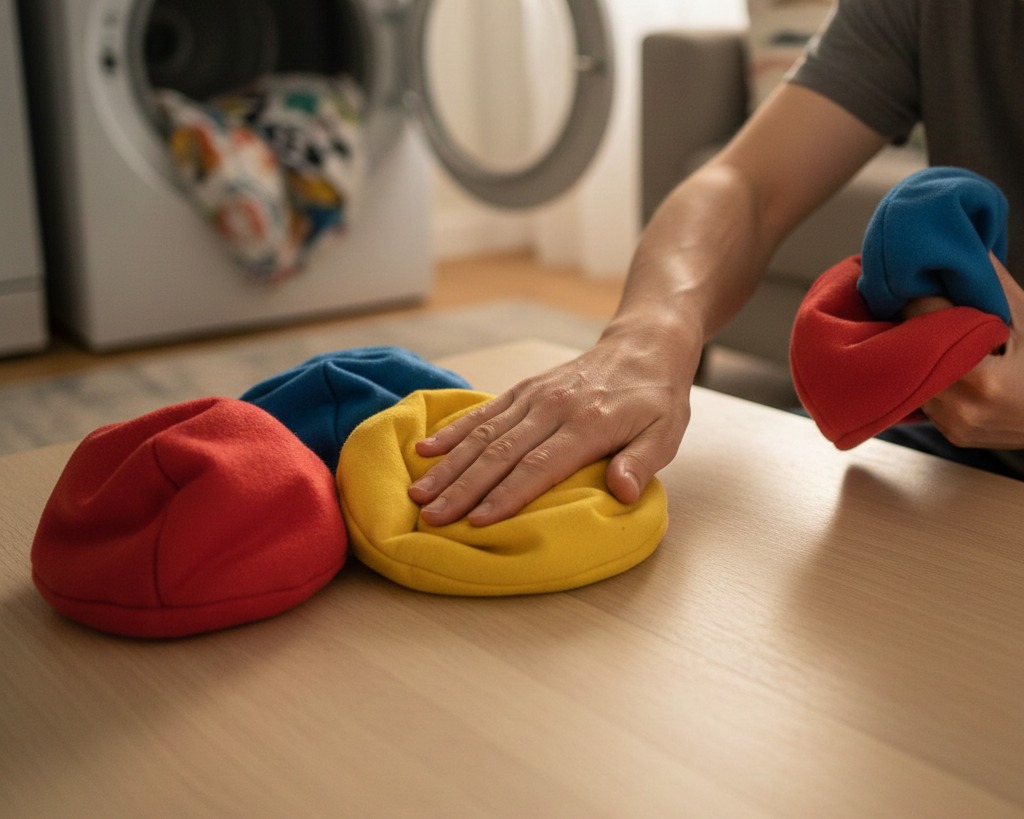
Place one bean bag on a hard, flat surface. Use the heel of your hand to apply firm pressure. Roll the bag in circular motions. You should imagine you are kneading bread or pizza dough. This movement stretches the synthetic leather or grain of the fabric. The internal plastic pellets spread out during this process. You should flip the bag every thirty seconds. Repeat this for two minutes.
This technique breaks down the initial stiffness of the factory seams. You will notice a visible difference in the bag’s flexibility. Does the bag feel more squishy and responsive now?
2. The Dryer “Air Fluff” Technique
You can use household appliances to speed up the softening process. Put your bean bags inside a thick pillowcase first. Tie the end of the pillowcase with a strong knot. Set your dryer to the “air fluff” or lowest heat setting. Heat can melt certain types of plastic filling. You must avoid high temperatures at all costs. Run the cycle for ten minutes.
The tumbling action mimics hours of manual use. The warmth makes the outer shell more pliable. You should check the bags every five minutes to ensure they stay cool. Does this sound like an easy shortcut for you?
3. High-Impact Drop Practice
Sometimes you need to use a bit of force. Stand on a carpeted floor or a rug. Throw each bean bag downward with significant strength. Gravity and impact force the internal air out. The pellets settle into the corners of the fabric. This method mimics the natural “break-in” period of thousands of catches.
You should aim for a consistent spot on the floor. Repeat this twenty times for each bag in your set. You provide the necessary stress to the stitching without causing damage. You will find the bags become much easier to stall on your hand. Ready to vent some frustration on the floor?
4. The Manual Seam Massage
The seams are the stiffest part of any juggling bag. Hold one bag between your thumbs and forefingers. Work your way around every stitched line. Squeeze and twist the fabric gently. You help the internal millet or pellets reach the very edges. Most manufacturers leave a small gap near the closure. You should focus your energy on this specific area.
This manual attention ensures the bag becomes perfectly spherical when airborne. You can do this while you watch a video or listen to music. Small movements lead to a massive improvement in feel. Can you feel the tension leaving the fabric?
How to “Break Into” Juggling: A Quick Start for Beginners
Follow these foundational steps to build your coordination and master the basic patterns of juggling with your new, soft bags.
Step 1: The Single Toss (Finding Your Height)
Start your journey with a single bean bag. Hold your arms at a natural ninety-degree angle. Toss the bag from your dominant hand to your non-dominant hand. You should aim for a height just above your eyes. The bag should follow a smooth arc. You want to catch the bag at the same level you threw it.
Focus on the peak of the throw. Your eyes should track the top of the arc. Repeat this until the motion feels like a reflex. You are building the muscle memory required for complex patterns.
Step 2: The Two-Bag Exchange (The “X” Pattern)
Pick up a second bean bag. Hold one in each hand now. Toss the first bag toward your opposite hand. You must wait until it reaches its highest point. Toss the second bag under the first one at that exact moment. This creates a cross or an “X” shape in the air. Catch the first bag, then catch the second.
You should use the rhythm: “Throw, throw, catch, catch.” Avoid the temptation to pass the bag across your waist. Every throw must go up and over. You will drop them often during this stage.
Step 3: Mastering the Three-Bag Cascade
The three-bag cascade is the classic juggling pattern. Hold two bags in your lead hand and one in the other. Toss one bag from the hand with two. Wait for the peak and throw the bag from your other hand. You must throw the third bag when the second reaches its peak.
This creates a continuous loop of motion. You should think of it as a series of “Step 2” exchanges. Keep your back straight and your elbows tucked in. The bags should stay in a single plane in front of your body.
Pro Tips for Faster Progress
Here are the professional tips for faster progress organized into bullet points:
- Consistency beats intensity every single time.
- You should practice for fifteen minutes every day.
- Short sessions prevent physical fatigue and mental frustration.
- Stand over a bed or a couch while you train.
- This prevents you from bending down to the floor.
- You save energy and keep your focus on the pattern.
- Visualize the arc of the bags before you start your first throw.
- You should imagine the bags moving in a perfect, glowing “X” shape.
- Listen to the sound of the catches.
- A steady beat indicates a balanced rhythm.
Conclusion
Breaking in your juggling bean bags changes your entire learning experience. Soft bags stay in your hands and reward your efforts. You now have four fast methods to prep your gear. You also have a clear roadmap to master the three-bag cascade. Juggling improves your hand-eye coordination and provides a great mental break.
You should celebrate every small victory along the way. Drops are simply data points for your brain to process. Your progress depends on your patience and your willingness to keep tossing. You can turn those clumsy drops into confident catches with just a little bit of daily effort. Are you ready to show off your new skills to your friends?
Stay ahead with expert features and guides at Xkamlab.com.

